

Mayin Connects
Leading Through Crisis
July 2026 | Virtual Event


What happens when an event on crisis management faces a crisis of its own?
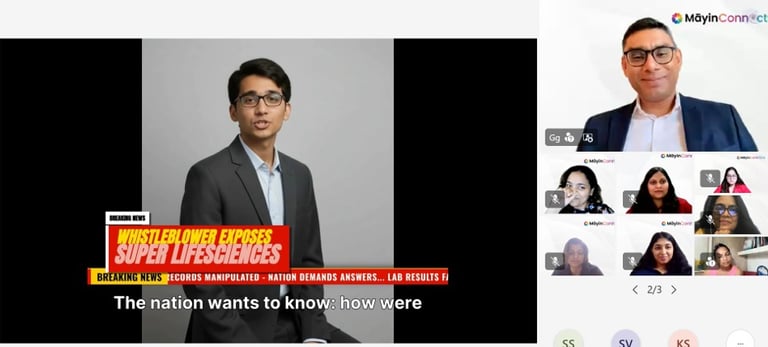
This edition of Mayin Connects was truly one of a kind. While we had carefully planned an immersive crisis simulation for our participants, the incessant rains decided the Mayin team needed one too!
Keeping everyone’s safety in mind the event was moved to a virtual format the very morning of the event. While we had already planned for this possibility, having a plan and living through it are two very different things.
Perhaps there could not have been a more fitting way to begin a conversation on Leading Through Crisis.
The first session, facilitated by Mr. George Ittyerah, placed participants in the role of a senior leadership task force navigating an unfolding business crisis. Working in groups, they had to assess the situation, identify priorities and develop responses as new challenges emerged. What made the simulation powerful was seeing the range of perspectives and approaches participants brought to the same situation; and how differently people thought, felt and responded under pressure.
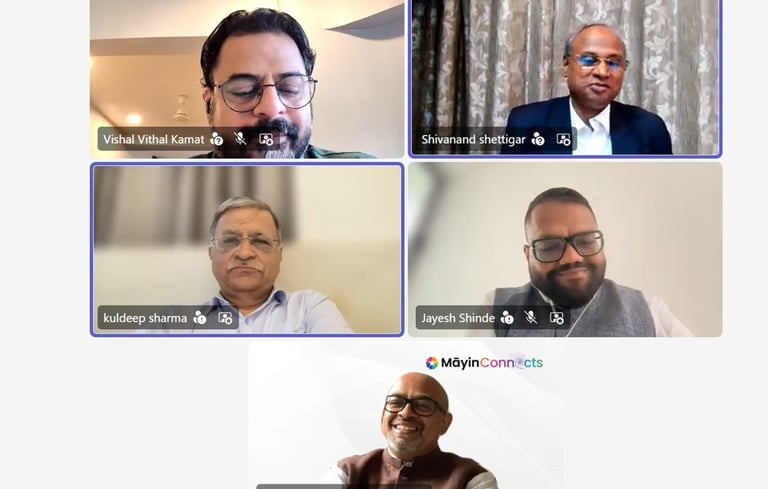
The second session moved from simulation to lived experience. Moderated by Mr. Charudatta Pande, the panel brought together Mr. Vishal Kamat, Mr. Shivanand Shettigar, Mr. Kuldeep Sharma and Mr. Jayesh Shinde, each bringing a distinct perspective shaped by their own experiences of navigating crisis.The conversation spanned leadership, people, governance, reputation and communication. Different experiences and different lenses — yet several consistent themes emerged
• Prepare before the pressure arrives. Crisis readiness is built through clear roles, decision rights, governance and empowered people who have the authority and confidence to act when circumstances change quickly.
• Trust and reputation are built before they are tested. The credibility an organisation earns over time becomes one of its most valuable assets in a crisis — shaping how stakeholders interpret its actions and whether they are willing to stand by it.
• Shape the narrative before assumptions take over. In a crisis, different stakeholders see different parts of the “elephant.” Effective communication requires transparency, consistency, and sensitivity to what matters to each stakeholder group. Organisations may not be able to give everyone the full picture immediately, but they must ensure that stakeholders understand the part of the picture that affects them — clearly, credibly, and before assumptions fill the gaps.
• Ringfence the ownership structure, especially in family-led businesses. Where equity stakes and decision-making rights are held by family members, a crisis can quickly affect governance, alignment, and control. Crisis planning must therefore factor in family shareholders and ownership interests, ensuring clarity, consistency, and disciplined decision-making during critical moments.
• Prioritise payments that protect continuity and trust. During a crisis, organisations must make disciplined choices around cash flows — giving priority to regulatory obligations, employee commitments, and critical vendors so that compliance, morale, supply continuity, and stakeholder confidence are not compromised.
• Protect people without losing accountability. Putting people at the centre of a crisis response does not mean compromising on responsibility. Strong leadership creates both psychological security and clarity around ownership.
And the most important one- Plans provide direction; resilience brings them to life. No crisis unfolds exactly as expected. Preparedness matters, but so does the ability to read the situation, draw on collective strengths and adapt without losing sight of purpose.
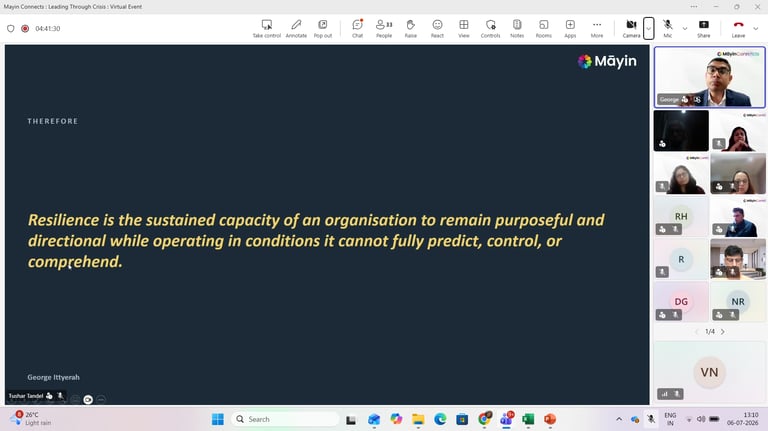
The final session, From Crisis to Resilience, brought the entire day together. George Ittyerah explored why knowing the procedure is not the same as being able to act on it under pressure, and how organisations can move from reacting to crisis to continuously anticipating, adapting and learning.
The session concluded by defining resilience as the sustained capacity of an organisation to remain purposeful and directional while operating in conditions it cannot fully predict, control or comprehend.
Looking back, perhaps the day could not have unfolded in a more fitting way. In a small but very real sense, our own experience reflected this journey; responding to the unexpected, relying on the people and trust built beforehand, and adapting without losing sight of what we had set out to do.The format changed. The technology tested us. People adapted. The conversations continued.
A truly memorable edition of Mayin Connects, one we will remember not just for what was discussed, but for how the day itself brought those ideas to life.
Address
Mayin Advisory Services Private Limited
1105, Lotus Link Square,
DN Nagar, Andheri West, Mumbai 400053
Contact
+91 7021593738
contactus@mayin.in
© 2026 Mayin Advisory Services Private Limited